
 DONATE NOW
Duke University Department of Ophthalmology
Dr. Tseng’s research is targeting the problem of early diagnosis of glaucoma prior to noticeable damage to neurons.
Previous research by Dr. Tseng has demonstrated that patients with dying neurons, as occurs with glaucoma, have elevated levels of specific neuronal proteins. These protein markers can be utilized as biomarkers to diagnose primary open angle glaucoma (POAG).
Using two sets of patients at Duke Eye Center, the research objectives are:
Aim 1: To measure the presence of the specific neurodegenerative markers associated with recently diagnosed new POAG cases.
Aim 2: To measure the presence of the specific neurodegenerative markers associated with POAG patients that exhibit disease progression.
Abstract:
Primary open angle glaucoma (POAG) is a neurodegenerative disease of the visual pathway in which irreversible blindness result from progressive loss of retinal ganglion cells (RGCs). However, intraocular pressure and visual field testing are unreliable for POAG screening. Consequently, clinicians currently lack effective methods to diagnose POAG early. Therefore, our goal is to identify and develop POAG biomarkers for early diagnosis.
We hypothesize RGC degeneration releases neuronal proteins into the blood. Autoantibodies against these proteins can serve as POAG biomarkers. These autoantibodies will be present in the serum or tear film in small quantity. Therefore, the goal of this proposal is to develop sensitive proteomic assays to these autoantibodies, and test them in POAG patients. Previous studies by other investigators have examined autoantibodies to inflammatory markers. However, researchers know little about autoantibodies targeting neuronal proteins released from dying neurons.
In preliminary work, we have already developed an assay to detect low levels of autoantibodies against these neuron-specific proteins, such as tau, MAP, and neuron enolase. Furthermore, our preliminary data have demonstrated elevated autoantibody levels of specific neuronal proteins in POAG patients recruited at the Duke Eye Center. Here, we propose to expand our preliminary work into a larger clinical study and validate these autoantibodies as serum and tear film biomarkers.
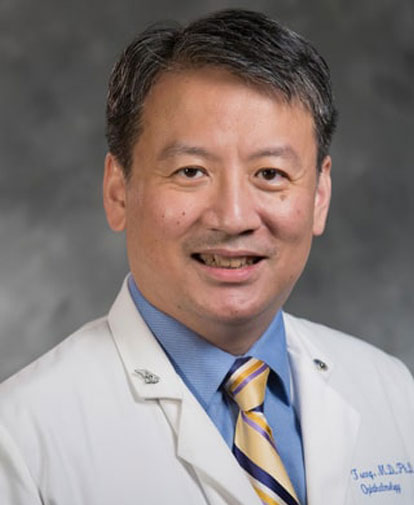
Henry Tseng, M.D., Ph.D.
Assistant Professor
Duke University Department of Ophthalmology
2531 Erwin Rd.
Durham, NC 27710
Email: henry.tseng@duke.edu